
Grab your coffee, or whatever’s passing for coffee today. I want to tell you about a podcast episode that made me feel calmer about something I’d been quietly freaking out over.
You know the thing. AI. And the little voice that asks, “What is this doing to my kids’ brains?”
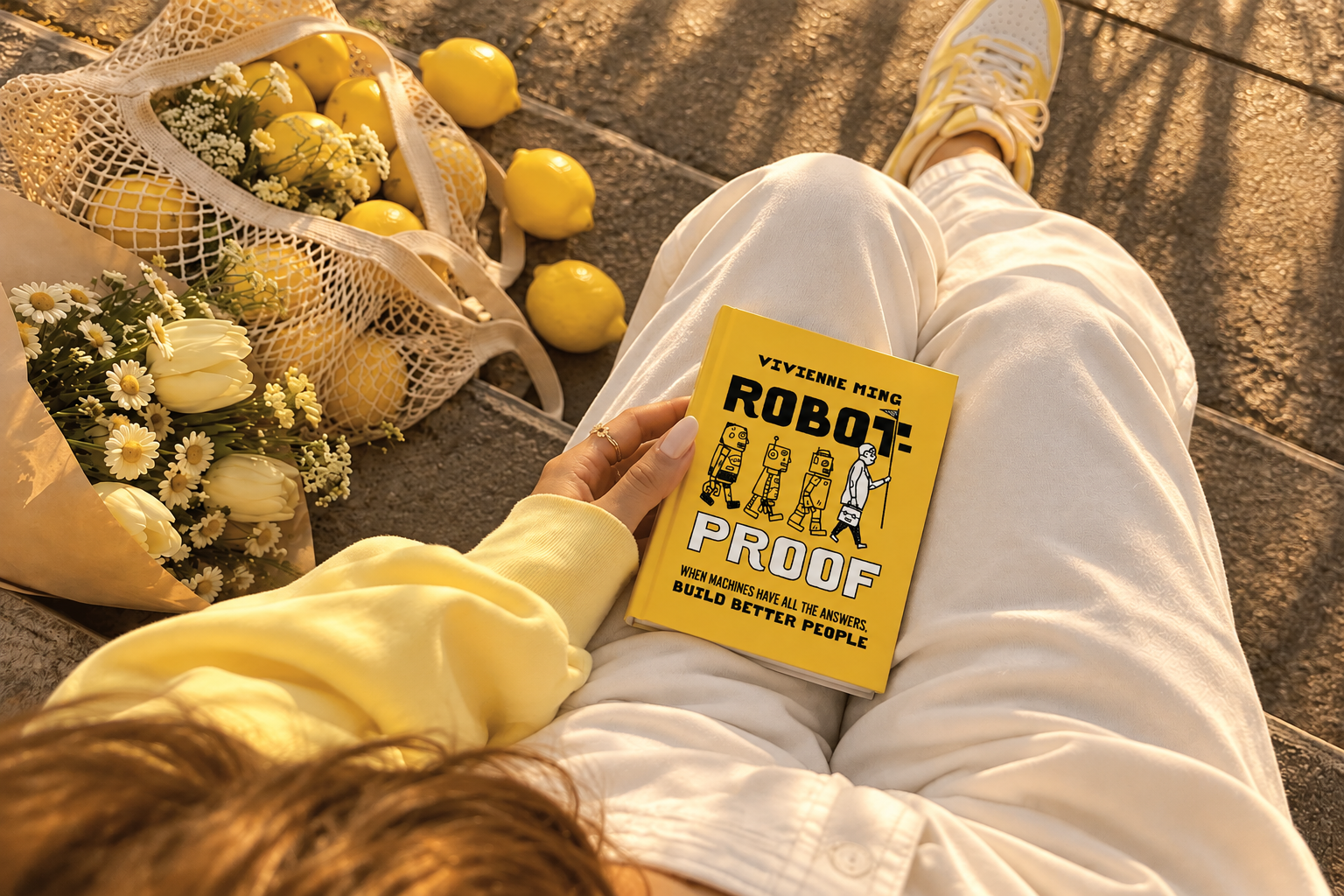
I’m not an expert. I’m just a mom who listens to podcasts all day. But Dr. Vivienne Ming is one: a neuroscientist who has spent about thirty years studying how humans and machines think together. She wrote Robot Proof: When Machines Have All the Answers, Build Better People, and here are ten things that stuck with me.
1. Copy-paste brain vs. ping-pong brain
Dr. Ming had UC Berkeley students predict real-world events, like the price of oil six months out. Alone, they did badly. Even the weakest AI did far better. But when they teamed up, 60 to 80 percent of the students just copied the AI’s answer, and their brain effort dropped by about 40 percent. She compared it to going from solving math problems to watching TV.
Then came the plot twist. A smaller group went back and forth with the AI. They challenged it, and it challenged them. She calls them “cyborgs,” and they beat both the best human and the best AI.
It’s the difference between watching a cooking show and actually cooking. Both involve food. Only one gets dinner on the table.
What I can tell my kids: “Use AI like a sparring partner, not a vending machine.”
How: One simple rule: never take the first answer. Ask it, “What’s the best argument against this?” Then decide for yourself.
Why: The thinking is the workout. If the machine does your push-ups, your muscles don’t grow.
2. Feeling like you understand isn’t really understanding
This one stung. Research on active learning shows kids learn more when they’re challenged, but they feel like they learned less, because the challenge exposes what they got wrong. Dr. Ming says AI makes this worse. Most chatbots are built to keep us happy and engaged, so they praise our ideas or bury us in facts. A smooth, confident answer feels like understanding, even when it isn’t.
Feeling smart and being smart can look identical from the inside.
Sometimes what a kid needs isn’t the answer at all. It’s a hint and some quiet time to think. Apparently AI isn’t great at giving that.
What I can tell my kids: “If it felt too easy, double-check that you actually learned it.”
How: After homework, have them explain the idea back to you like they’re teaching a younger kid.
Why: If you can’t explain it, you borrowed it. And borrowed knowledge tends to disappear by Friday.
3. It’s the kid, not the tool
Here’s what surprised me. The ping-pong kids did almost as well with a small, basic AI as with the fanciest one. So the secret wasn’t the machine. It was four qualities in the person: curiosity, intellectual humility, seeing other points of view, and flexible thinking.
The curious ones kept digging even when an answer was merely okay. The students low in intellectual humility either gave in to the AI completely or ignored it completely. Different outfits, same mistake.
Confidence isn’t never being wrong. It’s being wrong and being okay.
What I can tell my kids: “Being wrong isn’t failing. It’s finding the door.”
How: Say your own “oops, I got that wrong” out loud, often, with zero drama.
Why: Kids copy what they watch us do. If I can’t admit a mistake, I can’t expect them to either.
4. The best AI might be the one that only asks questions
Dr. Ming’s team built an AI that never gave answers. It only asked questions. On its own, it performed the worst of all. But as a partner, it more than doubled the number of students working in that ping-pong “cyborg” mode.
Translation: a little friction is a feature, not a bug. The struggle is where the learning lives.
What I can tell my kids: “When you’re stuck, that’s not the end. That’s the good part.”
How: When they ask you for the answer, try, “What have you tried so far?” or “What do you think the first step is?”
Why: Getting a little stuck and working through it builds the muscle they need next time. Rescuing them too fast skips the workout.
5. Praise the question, not just the answer
My favorite finding of the whole episode. In a classroom study with 8- to 10-year-olds, teachers learned to praise interesting questions instead of only correct answers. Within six weeks, the kids scored higher on curiosity, asked more questions, and started exploring new material on their own. Six weeks! I’ve killed houseplants more slowly than that.
She also talked about “attentional praise,” which means honestly noticing what’s different about how a kid thinks, not just flattery. And when Dr. Ming hires people, knowing what AI can already do, those distinct thinking patterns and high curiosity are what she looks for most.
What I can tell my kids: “That’s a great question. I don’t know. Let’s find out.”
How: Be specific. Try, “I never would have thought to ask it that way.”
Why: Kids repeat whatever gets noticed. Notice the wondering, and you get more wondering.
6. Knowing why beats knowing how
Kids still need to know things. But AI is getting very good at the how. If a child doesn’t understand why something works, they can’t really join the conversation. They’re just a passenger.
Dr. Ming’s point is that humans have always been good at exploring the unknown. In her study, the humans explored and the machines kept those explorations grounded in data. That’s a great partnership, but only if we show up with the exploring part.
What I can tell my kids: “Don’t just learn the steps. Ask what makes the steps work.”
How: When they show you an answer, ask, “Why does that work?” Make it a game, and be willing to say “I don’t know, let’s find out” when it’s your turn.
Why: Understanding the why lets you handle a problem you’ve never seen before. Memorizing the how only helps with the ones you’ve already seen.
7. There is no “average kid”
Dr. Ming sees the same pattern with AI that researchers see with social media. Many kids get hurt by it, but not all. The ones who do well slow down and think critically. Developmental psychologists call this differential susceptibility, which is a fancy way of saying the same thing lands differently on different kids, depending on temperament, curiosity, and circumstances.
So advice written for the “average child” fits nobody exactly. The most useful thing I can do is watch my kid.
There’s no manual for the average kid, because the average kid doesn’t live at your house.
What I can tell my kids: “I’m not here to catch you doing it wrong. I’m here to see how it works for you.”
How: Watch for the signs. Do they get more curious after using AI, or more checked out? Do they slow down, or rush? Then adjust.
Why: Kids open up when they feel seen, not scanned. Curiosity from you will probably invite honesty from them.
8. The surprising stuff matters most
Dr. Ming looked at two giant piles of data. One tracked job performance across 122 million people. The other followed kids for years to see how life turned out: health, friendships, happiness, even how fast they walked at age 65. (Her favorite measure, because it says so much about a whole life. I loved this part.)
Both piles pointed to the same four things: resilience, curiosity, working memory, and a sense of purpose. The good news is that these can grow, especially with early enrichment. Reading together, telling math stories, and helping kids wonder why different people do different things all count.
What I can tell my kids: “Your brain isn’t finished. It’s still building, and you get a say in how.”
How: Read together, even with the big kids. Turn everyday math into stories (“If we double the pancake recipe, how many eggs?”). When someone acts differently then you expected, ask, “Why do you think they did that?”
Why: Skills that can grow need practice, and practice works best when it feels like play.
9. Machines change. We don’t.
Dr. Ming started writing her book about fifteen years ago. By the time she finished, almost nothing needed updating. Her explanation: the tech changes, but the fundamentals don’t, “because the fundamentals are us.” What makes a life go well would have held true in the Bronze Age and will hold true a hundred years from now.
My shoulders dropped an inch. I’d been treating AI like a crisis humans faced. It’s a new storm, sure, but we’ve always needed the same kind of house.
Technology is the weather. Character is the house.
What I can tell my kids: “You don’t have to be faster than a computer. You have to stay you.”
How: Name the human strengths out loud when you see them: “That was kind.” “You kept trying.”
Why: Kids can’t build on strengths nobody’s pointed out. Naming them turns invisible things into things they can aim for.
10. Nothing is make-or-break
This is the one I needed more than my kids did. Dr. Ming said it always feels like the next decision will determine everything, and that’s an illusion. What predicts a good life far more is purpose and meaning, even for lifetime earnings. People who do hard things for their own reasons do better than people doing them to impress others.
I’m going to let that sit here for a second, because I think a lot of us need it.
A kid with a “why” will outlast a kid with a gold star.
What I can tell my kids: “I care more about what lights you up than what looks good on paper.”
How: Ask, “What’s the hardest thing you chose to do this week, and why?”
Why: When the reason comes from inside, kids keep going after the applause stops.
What I Actually Want for My Kids
Here’s the thing I keep coming back to, long after the podcast ended.
I don’t want my kids to just survive the AI era. Surviving is the bare minimum. That’s the “made it through the airport with all the luggage” version of success.
I want them to use it, the way you’d use a good tool: to build things, to learn faster, to chase the ideas they’re too curious to leave alone. And I want them to stay the kind of people who’d still know who they were if the Wi-Fi went out.
Originally published on xoxoCalimom on Substack.
Leave a Reply